
Inside Canyon County Tax Records
Canyon County property tax records blend two offices. The Assessor estimates market value each January 1 and keeps parcel facts plus exemptions. The Treasurer gathers the real, personal, and operating rolls. It then posts bills, balances, and payment history. Check the record year on any two fields before comparing them.
| Field | What It Shows | Where |
|---|---|---|
| Current assessed value | Mass-appraisal estimate tied to the January 1 valuation date | Assessor parcel card and notice |
| Ownership and PIN | Roll name and the ten-character parcel key | Assessor Public Access |
| Exemption indicator | Relief reflected on the current card or notice | Assessor record |
| Tax bill and balance | Amount billed, current balance, and payment status | Treasurer Public Access |
| Five-year history | Assessment notices, tax bills, payments, and eStatements | Data Hub |
Idaho assesses at one hundred percent of current market value. Yet that assessed figure is still not a recorded sale price or a private appraisal. Idaho is also a non-disclosure state. Because of that, the public systems cannot serve as a full sales database. The tax bill layers taxing-district charges, exemptions, and credits onto the roll. That layering is why a small value move can shift the tax bill. The shift can be a very different percentage.
The parcel card often adds a short legal description, lot size, and a last-transfer reference. Those fields confirm the bill matches the right land. That matters when a mailing address differs from the physical situs. Treat them as cross-checks only. A short legal description never substitutes for the full deed or plat.
Find Canyon Tax Records
The Canyon County Real Estate Search is the dependable route to the parcel. Guests can search by PIN or property address. Advanced or registered access opens owner and legal-description criteria through Search Options. From the parcel card, grab the key that unlocks the Treasurer's tax tools.
| Input | Access | Useful result |
|---|---|---|
| Parcel ID or PIN | Guest | Exact parcel card |
| Property address | Guest, partial or full | Situs matches |
| Search Type | Main or Contains | Broad or narrow result set |
| Owner | Advanced or registered | Name-linked parcels |
| Legal description | Advanced or registered | Lot, block, or tract matches |
With addresses, type the street number and name only, leaving off direction and suffix. Less text beats more when the first attempt fails. Search Type "Contains" plus an asterisk wildcard widens the net. For the Data Hub, keep the exact PIN, spaces and letters included.
Registered Public Access goes beyond the guest display. It adds taxes due, value history, ownership history, and building traits. Note the account state you used. A field hidden from the guest card may sit behind registered access. Its absence there says nothing about county data.
Canyon County's Annual Tax Cycle
The Assessor values property as of January 1 through mass appraisal. Assessment notices generally begin mailing in June. The Treasurer prepares notices by the fourth Monday in November and collects the property tax roll. Those dates create a sequence rather than one live number.
A deed may record after the assessment roll's effective date, so the ownership name can lag the newest transfer. That lag does not erase the bill or change which parcel the PIN identifies. Compare the assessment year, notice, current Treasurer balance, and last-transfer reference before deciding that two systems conflict.
The offices have distinct roles. The Assessor sets and explains value and maintains exemption information. The Treasurer collects the rolls, posts payments, and handles eStatements. The Recorder holds the deed trail. Direct a factual building issue to the Assessor and a posted-payment issue to the Treasurer instead of sending one broad request to every office.
Note: Use the PIN and record year as the common keys when ownership, valuation, and payment screens show different update dates.
Read Canyon Assessment Notices
The county's assessment-information page explains notice review and the evidence used in an appeal.
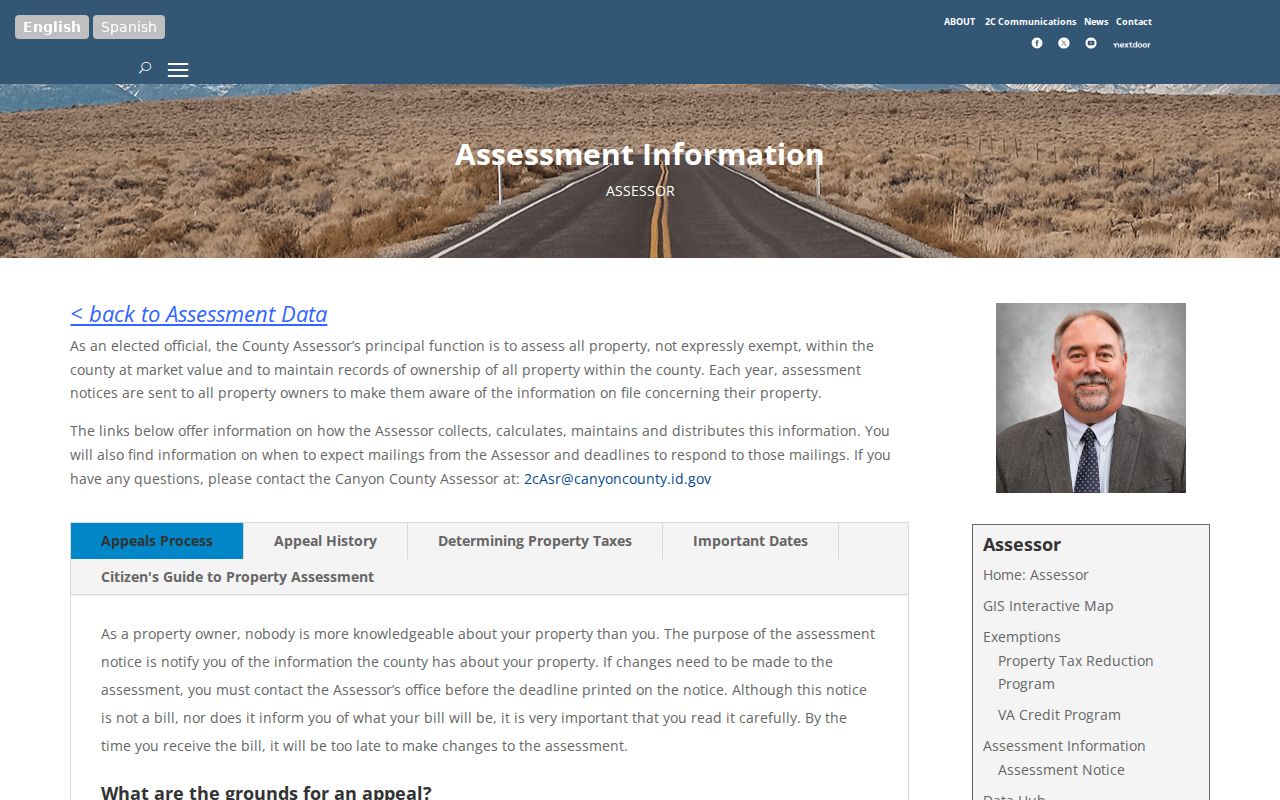
Look to the notice's upper-right corner for the parcel number that anchors any review. Check the factual traits: living area, lot size, bathrooms, garage, basement, year built, materials, and condition. Comparable sales offered as evidence should be arm's-length sales predating January 1 and should resemble the property and neighborhood as closely as the record permits.
Look Up Canyon County Tax Bills
Start a tax-bill lookup with the Assessor's parcel result, then carry that number into the Treasurer's records. The Treasurer's live Tax Search endpoint works, though its dynamic field labels vary by screen. Trust only the search modes the current display actually shows.
- Find the parcel in Assessor Public Access and copy its exact PIN, situs, owner display, and assessment year.
- Open the Treasurer's current Tax Search. Use a verified live field to select the same parcel.
- Read the bill, current balance, and payment history. Keep the tax year with each amount.
- Compare the current Assessor card or notice for exemption information, then use the Data Hub for prior years.
- Contact the Treasurer when a payment, delinquency, or account status needs official confirmation.
- Assessed value
- The Assessor's value for the stated roll year before the bill is read.
- Market value
- The Assessor's estimate of current market value as of January 1, not a guaranteed sale price.
- Levy
- The rate imposed by the applicable taxing districts to produce the tax charge.
- Homeowner exemption
- Property-tax relief that requires a timely application and appears on current records when approved.
- Tax lien
- A legal claim tied to unpaid property tax; confirm its status with the official record.
Five Years of Canyon Tax History
The county's five-year Data Hub gathers assessment notices, tax bills, payment history, eStatements, and recurring or monthly payment tools under one roof. Its form takes a ten-character PIN. It also takes a partial or full address, a city choice, and a year choice. For addresses, skip punctuation, abbreviate Drive, Avenue, Street, and Road, and begin with less information. A leaner first query beats a crowded one.
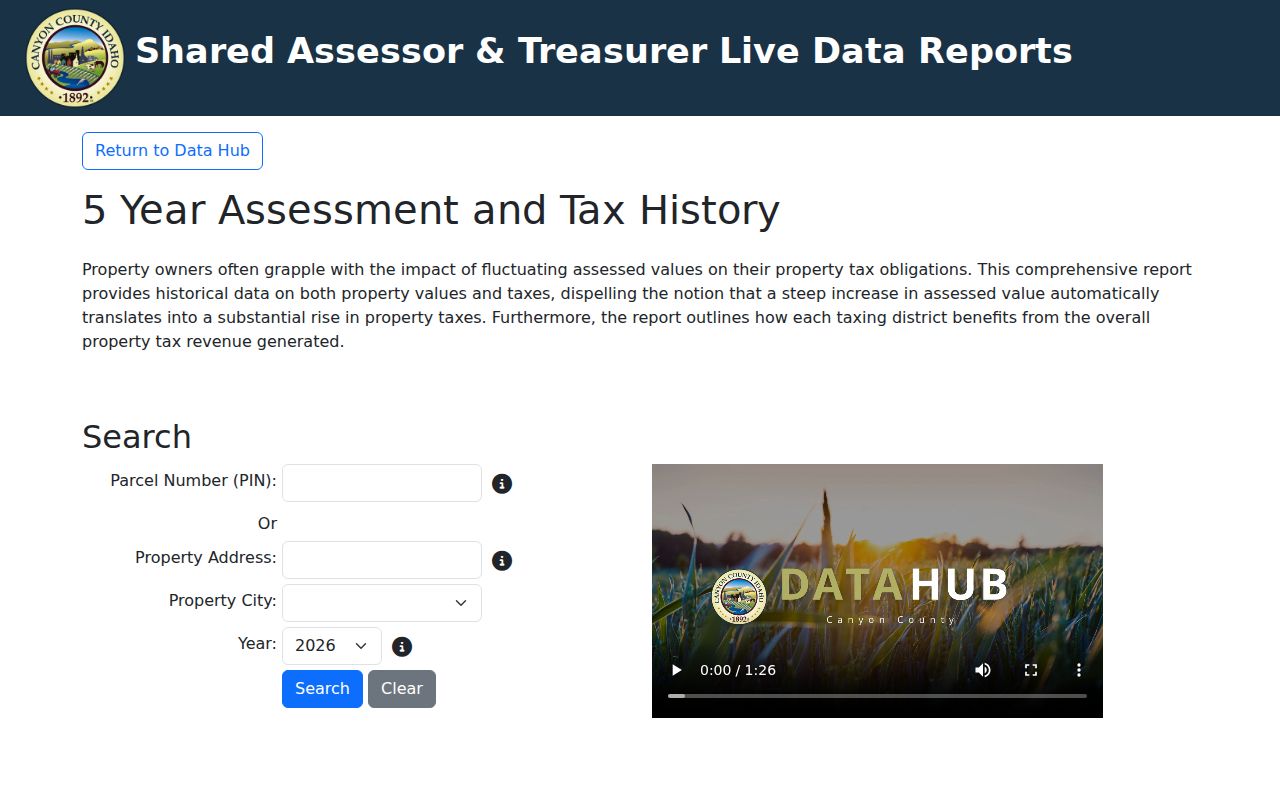
The Data Hub's year filter makes multi-year comparison simple. Compare like fields across years rather than merging assessment and tax into a single trend. The county cautions that gross history includes school savings. It excludes State Reimbursement Credits. It also may not fold in HTR or ATR credits. eStatements stay online for five years. They can replace mailed statements under Idaho Code §§63-308 and 63-902, with a free paper copy on request.
Note: Save the year, gross-tax basis, and credit treatment alongside any figure pulled from the five-year history.
Canyon Treasurer Balance Screen
The official Canyon County Treasurer tax-search endpoint is the current-balance and payment source.
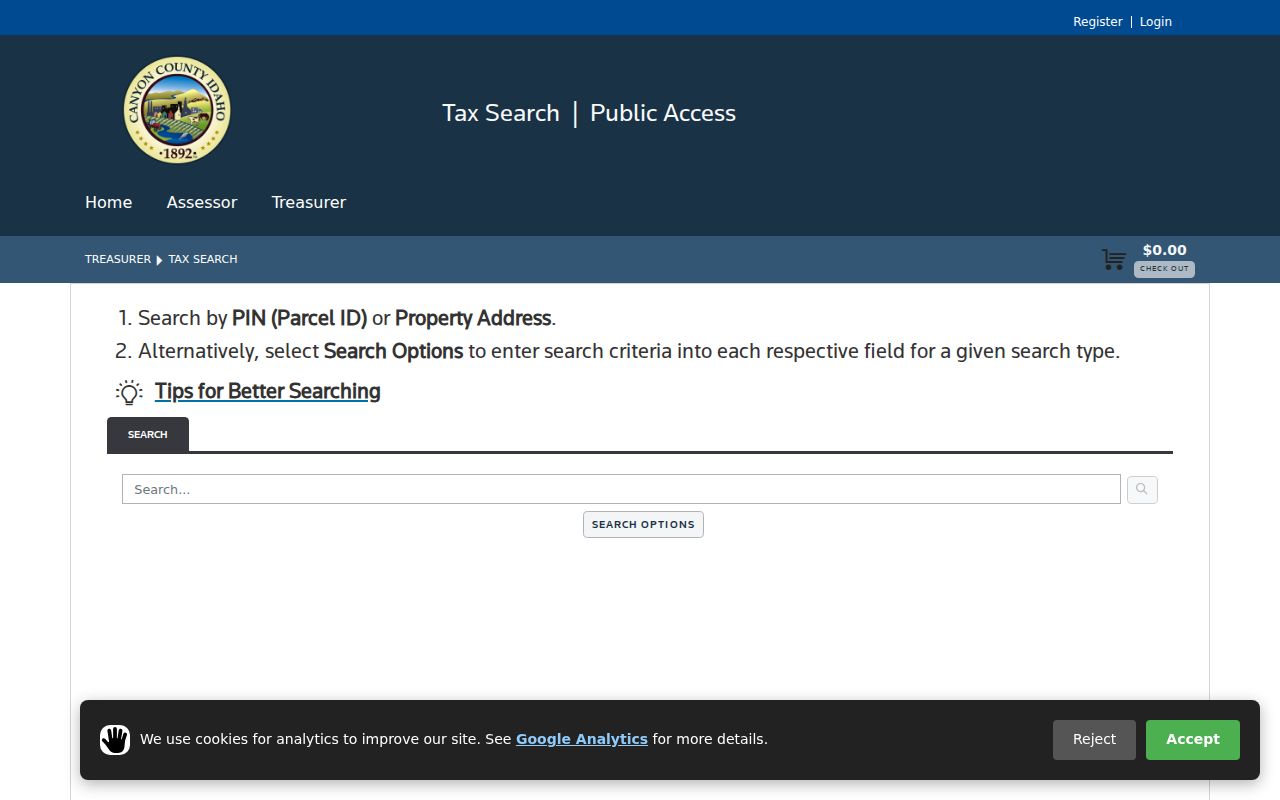
The screen's controls change with the search. Work from whatever modes the live page shows. A tax bill lookup there reflects the current balance the Treasurer holds. Treasurer Jennifer Watters' office sits at 111 N. 11th Avenue, Suite 240, Caldwell. Hours run 8:00 a.m. to 5:00 p.m. weekdays. The office answers at 208-454-7354 or treas@canyoncounty.id.gov.
Canyon Homeowner Exemption Timing
April 15 is the homeowner-exemption deadline the Canyon County Assessor publishes each year. Ownership alone proves little here. A parcel card showing your name does not confirm the exemption was filed. It also does not confirm approval, or that the exemption was applied to the current notice. Before relying on it, read the current card or notice. Then ask the Assessor about the active year's status. Only a deeded owner may request a mailing-address change. The county verifies deeded ownership before acting. Remember that a mailing address is just where tax correspondence goes. It is not the situs where the parcel lies. That distinction matters when a notice lands elsewhere or an entity owns the property. The Assessor can be reached through its official office page.
Canyon City Values Barely Shifted
City property values in Canyon County barely moved. A 2026 report put the average assessment for properties inside county cities at $484,655. That was up from $480,509 in 2025. The rise is under one percent. Treat the figure as countywide context, never as a forecast or an appraisal for one parcel. Neighborhood, land, building traits, and condition still matter. The January 1 appraisal date matters too. These still control the individual record. The comparison that actually helps is a parcel's own five-year assessment series. Set it beside its notices and tax bills. A county average frames the backdrop. It cannot replace the subject parcel's property tax records or the evidence needed for review.
Appeal a Canyon County Assessment
Start informally when the notice contains a factual error or the value lacks support. Bring the PIN, your contact details, the disputed fact, and focused evidence. The county's prompts cover building style, area, lot size, room and improvement facts, age, materials, condition. They also cover comparable arm's-length sales before January 1. Ask to meet the reviewer if the record needs explanation. A formal appeal takes a different path. File it in writing with the reviewer or the Board of Equalization under Idaho Code §63-501A. Follow the notice calendar. Attach the notice, identify the parcel, and state each correction. Include comparable evidence or a same-neighborhood analysis. The county publishes no separate filing fee for this appeal.
Appeal window. The filing date and submission method follow the current assessment notice calendar. Confirm both with Canyon County before the notice deadline.
An appeal challenges the assessment itself. It does not reopen the Recorder's ownership chain or a GIS boundary. For a fuller explanation of assessed value versus market value and sale price, see the Canyon County property value resource.
Always retain the report year, PIN, and access date with every copied tax figure.