
Compare Canyon County Property Value Types
Canyon County values property with a mass appraisal set to January 1. One deed may show a different number entirely. The market value estimate, the taxable figure after adjustments, and the consideration listed on a deed each answer a separate question about the same parcel.
| Value type | Meaning | Record source |
|---|---|---|
| Assessed value | Annual mass-appraisal value used in taxation | Assessor card and notice |
| Current market estimate | Assessor's January 1 estimate at Idaho's 100% level | Assessment record |
| Sale consideration | A past transfer amount when actually reported | Recorded deed |
| Private appraisal | A professional opinion for a stated date and purpose | Not a county portal record |
Idaho's 100% assessment level does not make the roll a forecast of what a parcel will sell for. Dates, methods, property traits, exemptions, and the underlying evidence still differ from one figure to the next.
Read Canyon County Assessed Value in Context
The Assessor parcel search shows ownership, assessed value, the PIN, a short legal description, lot size, and the last-transfer reference. Registering adds value history and building traits. Note the roll year too. Confirm the situs, PIN, and description all point to the parcel you intended.
Assessed value is the roll figure used for taxation. Market value estimates a price under open-market conditions. Assessment level refers to Idaho's 100% market-level standard. Reassessment means a later valuation cycle, never a sale.
Ownership details and building traits add context. Neither one guarantees condition or price. Mass appraisal values groups of similar properties, while a private appraisal answers one specific assignment on one parcel.
Open the Canyon County Property Value Record
The official Assessor search is the entry point for a current parcel value.
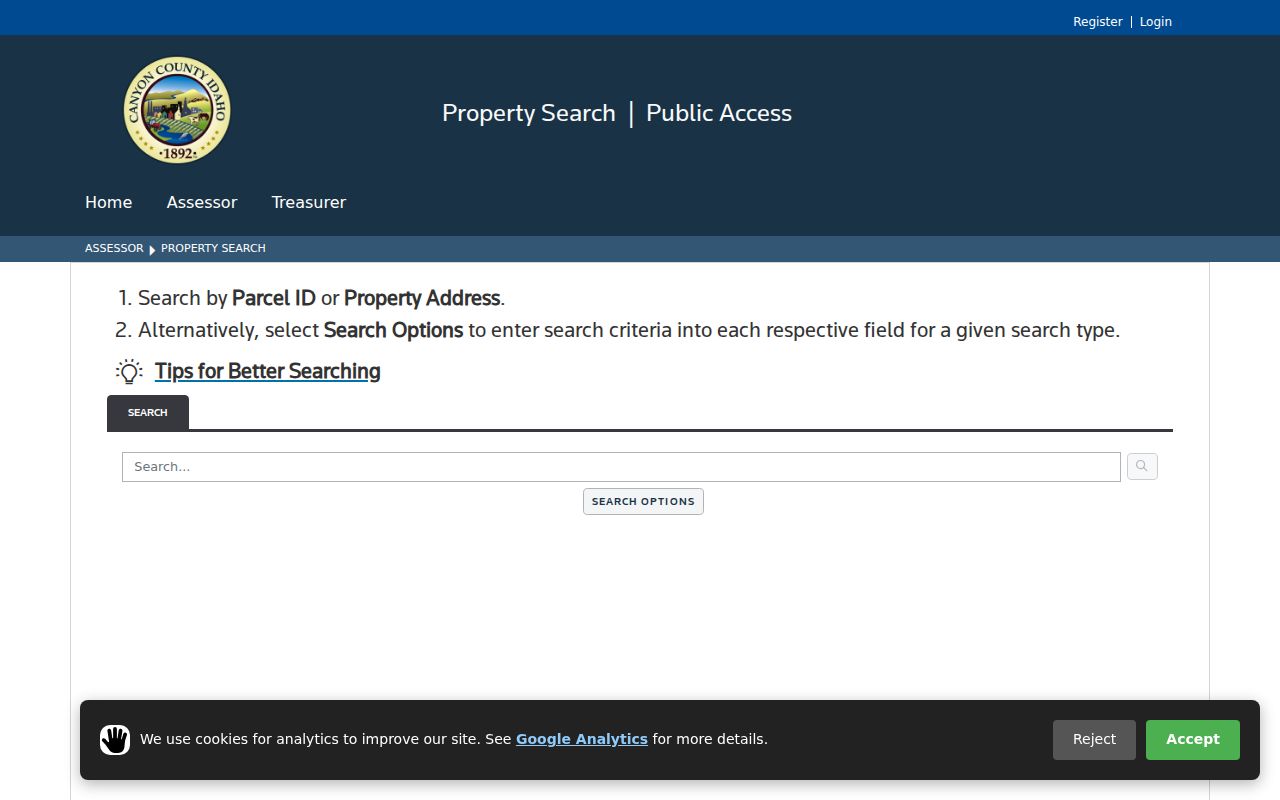
Pick the correct address or PIN first. Then preserve the amount together with its roll year rather than copying a bare number stripped of context.
Estimate Canyon County Property Value From Records
This lookup collects evidence; it does not produce a promised selling price.
- Search the address, omitting direction and suffix when needed, or use the exact PIN.
- Save assessed amount, year, lot size, description, and available building traits.
- Review the five-year Data Hub for dated changes.
- Use the last-transfer instrument to find a deed, noting that consideration may be blank.
- Obtain a private appraisal when the decision requires a parcel-specific opinion.
- Valuation date
- The date to which an estimate applies.
- Consideration
- A transfer amount that may or may not appear in a deed or index.
- Comparable evidence
- Arms-length sales and facts used to test value.
Compare Five Years of Canyon County Value History
The Assessor and Treasurer Data Hub covers up to five years of assessment notices, tax bills, payment history, and eStatements. Enter a ten-character PIN, a partial or full address, a city, and a year. Searches work best when you drop punctuation, abbreviate street types, and use fewer words if nothing comes back.
The history reveals when an assessment changed. It is not title history. Nor is it a complete sales database. Gross figures may include school savings. They may leave out State Reimbursement Credits. HTR or ATR credits may not be incorporated. Remember that assessment series and tax series are different variables.
Note: Preserve the year, source, and credit treatment when comparing two amounts from the Canyon County Data Hub.
Separate Canyon County Sale Clues From Assessed Value
The Assessor's last-transfer instrument points to the Recorder index. There you may see the deed type, the parties, the recording time, and the fee. The consideration line can sit blank. Idaho is a non-disclosure state. So no public portal should be called a complete sale-price database.
When a deed does report consideration, confirm the legal description and transfer context first. Family transfers, partial interests, and trust changes may not reflect the open market. An old amount also says little about the property's value today.
Place Canyon County Value on the January 1 Cycle
The Assessor estimates current market value as of January 1, with annual notices generally beginning in June. A later remodel, damage event, split, replat, or annexation may fall on another record schedule.
Review materials ask for facts such as living area, lot size, bathrooms, garage, basement, year built, materials, condition, and arms-length sales before January 1. GIS Land Value and Building Characteristics layers add reference context, but the dated parcel card and notice remain the assessment records.
Keep Canyon County's 2026 Value Trend in Scale
One countywide comparison tracked properties inside Canyon cities. The average moved from $480,509 in 2025 to $484,655 in 2026. That rise stays under 1%. Treat it as a dated regional trend, not an estimate for one parcel.
Nampa, Caldwell, Middleton, and unincorporated land each carry a different property mix and timing. Rely on the subject parcel's roll, value history, and traits to judge its worth. Weigh the legal description and credible sale evidence too.
Test Canyon County Property Value Against Parcel Facts
Mass appraisal is only as good as the traits attached to the right parcel. The Assessor's informal-review prompts list the checks that matter. Expect architectural style, living area, lot size, bathroom count, garage, basement, year built, and materials. Condition rounds out the list. Compare each item against the dated parcel card. Support what you can with documents. A building trait is assessment data, not proof that city permits were pulled.
Geography can also explain why two nearby values differ without proving either wrong. County GIS layers cover Land Value, Building Characteristics, zoning, city limits, impact areas, subdivisions, PLSS, hydrography, permit locations, highways, and railroads. Dairies, feed lots, gravel pits, and mobile homes also appear. Use the maps to frame a question. Then return to the roll and the notice. A map line is not a survey. A planning label is not an appraisal adjustment.
For a platted lot, keep the subdivision, phase, block, lot, and any common-lot context. For rural land, record the section, township, range, tract, and survey calls. A split, replat, annexation, or road dedication can change parcel identity. Compare the PIN and legal description for each year. Do that before treating two values as one continuous series.
Create a Dated Canyon County Value Record
A good value worksheet stays short but precise. Save the PIN, situs, roll year, and assessment amount. Add any exemption indicator, parcel traits, and the last-transfer reference. Record the query you used, your access state, and the date. Registered access can show value history and building details that a guest result hides. Note which one you used.
| Record item | Capture | Caution |
|---|---|---|
| Assessed value | Amount and roll year | Not a sale price |
| Parcel traits | Exact reported fields | May need correction |
| Last transfer | Date and instrument | Consideration may be blank |
| Five-year history | Each year and source note | Credit treatment varies |
Spotted a number that looks off? Start with the Assessor's informal review route. You will need the assessment notice. You will also need the parcel identification number and a factual correction backed by support. If you lean on sales, the county wants comparable arms-length deals from before January 1. Keep this review apart from both a private appraisal and the tax-bill appeal process.
Online tools sometimes fail. That is not a dead end. Assessor staff and public computers in Plat Room 230 at 111 N. 11th Avenue in Caldwell offer another path. A public-record request can target one specific non-exempt record. Older county land and tax materials live at the State Archives. Historical values and current market estimates were built for different dates and purposes. Label each one before you compare them.
The Recorder index supplies a last check when land changed hands. It also works when a parcel split or moved into a trust. Record the deed subtype and the recording date exactly. Never infer a price from a fee or a blank consideration field.
Know What Canyon County Property Value Cannot Tell You
An assessment cannot promise what a buyer will pay. It does not establish condition, prove title, or certify a boundary, and it never replaces a private appraisal. Tax can move in different ways entirely, since rates, districts, exemptions, and credits all sit apart from value itself.
Value is not price. Canyon County assessed value supports taxation. It is not a sale guarantee or parcel-specific appraisal.
For bills, exemptions, and appeals, turn to the Canyon County property tax records guide. This page stops at the meaning and source of value numbers.
A solid worksheet holds several things at once. Record the current assessed amount and the roll year. Note land and improvement components where available. Include five-year values, any displayed exemptions or credits, and the January 1 valuation date. Add comparable-sale information only when a real recorded source reports it. Keep Treasurer gross tax amounts in a separate column. A tax change does not prove an equal change in assessed value.
If the online search fails, help is close. Assessor staff sit at 111 N. 11th Avenue, Suite 250 in Caldwell. The public computers in Plat Room 230 provide an in-person path. Bring the exact PIN, a normalized situs, and the notice year. A written public-record request can route a precise record description to the Assessor. Broad requests may trigger labor or page costs. Define the parcel, date range, and delivery format, and ask for an estimate.